Blood Music
2026-05-24
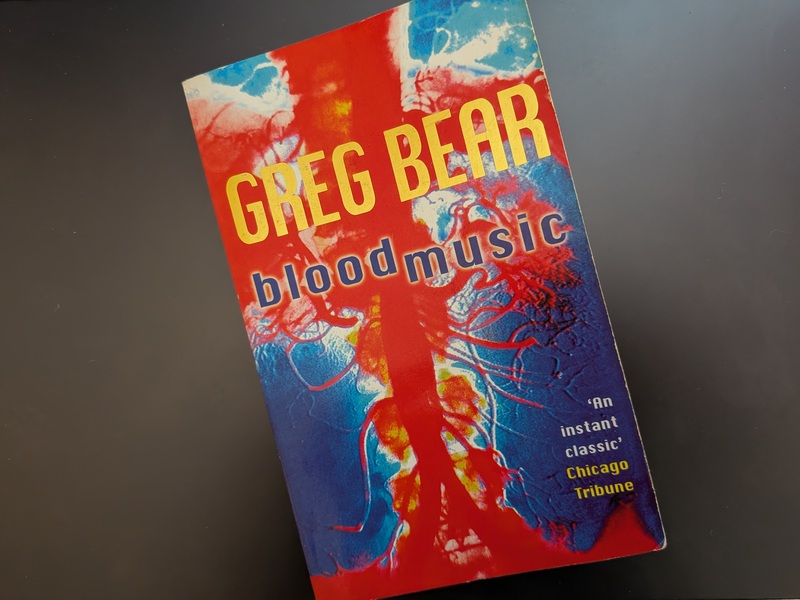
Blood Music by Greg Bear, first published 1985. 262 pages
Blood Music is a science fiction novel which deals with the dangers of unchecked scientific progress, the possibilities for human evolution and much more. The novel surprised me in the ways in which it raises the stakes and where it takes the narrative.
The book is divided into different phases, which links to the idea of the phases of a virus's evolution. In the first section we are introduced to the scientist Vergil Ulam who has gone rogue and uses his time to do unsanctioned experiments trying, and succeeding, in creating cells which can evolve and eventually achieve sentience.
But the higher ups at Ulam's company force him to destroy his work and fire him. Fearing he will lose all his progress, Ulam makes the reckless decision to inject the cells into his own body, hoping to find another lab where he can retrieve them.
Instead of this, the cells begin transforming his body and "improving" it, causing Ulam to be healthier, fitter and more sexually attractive. This sets up the central narrative of the story.
It takes Ulam some time to realise what is happening to him. When he does he ropes in a former university friend to help diagnose what is going on. Unfortunately he inadvertently shares his cells with his friends via a handshake and before longer the population of America becomes infected.
This sets up a new phase in the novel where the virus begins to take over north America while the rest of the world scrambles to cope with the threat.
I was struck with how the novel shifts gear through its different phases. Characters are dropped quite regularly and the focus of events shifts to different people and locations quite freely.
There seems to be a theme about evolution (or revolution) of humanity and eventually all of Earth's biology via the quickly evolving cells. While most humans in America are transformed into a mass biological intelligence, a handful are not. One character in particular resists letting the cells "evolve" her body, fearing losing herself in the process. While another scientist questions what the virus does to "bad" people such as psychopaths, murderers and rapists when it "improves" them. Does it make moral choices about how a character's mind should be changed?
Another strange concept introduced in the later part of the novel is the idea that sentient beings somehow influence and create physical laws rather than discovering them. The idea being that observing the science of nature somehow creates fixed laws, which were not fixed previously. It sounds pretty far-fetched and seems to be linked to the uncertainty principle. The virus itself reaches a physical limit whereby the universe cannot allow more than a certain number of conscious beings to co-exist without breaking reality itself.
The ending of the novel could be seen as a catastrophe or a rapturous event, depending on how you feel about the "evolution" of human consciousness to another plane of existence.
Overall I found this an extremely engaging and interesting book which nips along at a fast pace |(it feels more like a thriller than a heavy-weight philosophical work). Some of the imagery of the physically half-transformed humans is Cronenbergesque in its level of body horror.
The changing phases of the novel kept surprising me, it went places I didn't expect it to. Although there were a few characters whose story arcs seemed to fizzle out in a disappointing way.
But what I was left with has provided me with plenty to think about, which is always a sign of a good book to me.